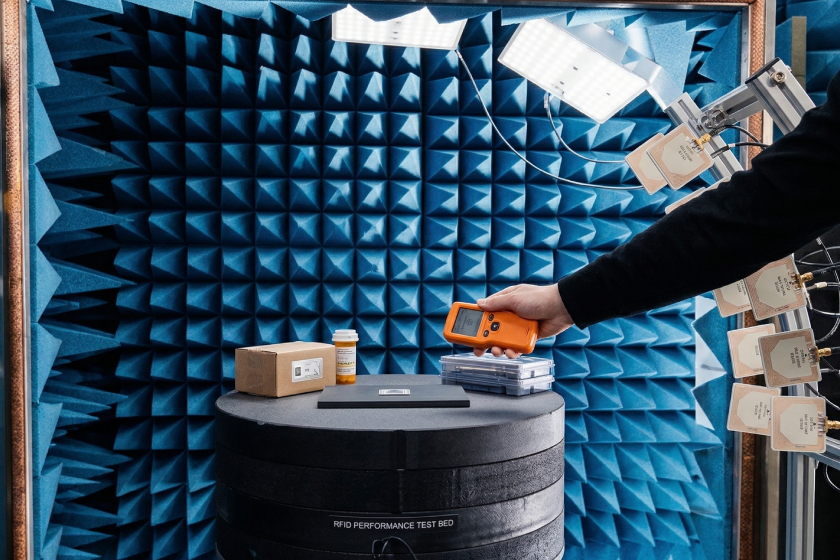
Anechoic chambers are essential tools for precision RFID testing, designed to create controlled environments that eliminate external radio frequency interference and signal reflections. These chambers use RF (Radio Frequency) blocking and absorbing materials to reduce noise or echoes, allowing for consistent testing across various RFID tag types and positions.
In addition to RFID research and development, these chambers can support specific frequency range testing and deliver insights into how tags perform in different applications and locations. The testing chamber makes it possible to measure RFID tag sensitivity, orientation effects, and signal stability — important data points for achieving reliable RFID performance in real-world deployments.
Expanding Our RFID Testing Capabilities
To support our RFID research and development, we conduct in-house RFID testing in our lab as a service to customers to ensure accurate RFID placement and read performance to ensure benefits of RFID.
This testing also allows us to evaluate labelling and packaging solutions using anechoic chambers to get read performance. This is especially helpful for determining RFID label placement on hard-to-tag items that contain metal, foil, or liquids, which can significantly affect RFID signal performance.
By testing these scenarios before deployment, companies can optimize label placement, improve read accuracy, and maximize the overall value of their RFID implementations.
How RFID Testing Works
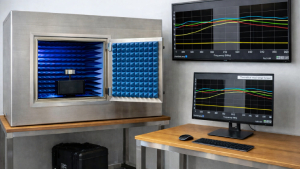
Testing in the chamber can be conducted in several ways depending on the application being evaluated.
Testing in the chamber can be conducted in:
- Free space (just the tag laying in the chamber)
- Card stock (RFID tag is placed on a paper card and read)
- On a product (RFID tags are placed on an item and read)
Testing tags directly on real products is particularly valuable when working with challenging materials such as metal surfaces, foil packaging, or liquids, which can interfere with RF signals and impact read performance.
Testing Output
As a result of testing, the Anechoic chamber can provide several different reports including theoretical read range and population testing.
Theoretical Read Range
Theoretical read range test is when you place a single tag in the chamber and test to see how far “theoretically” the tag will be able to be read. This type of test can give a good idea of the performance in the real world, but it cannot replace real world handheld testing.
The graph below shows theoretical read range comparisons between multiple RFID tag types.
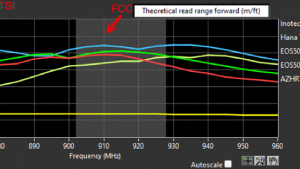
The horizontal axis displays frequency in MHz, while the vertical axis represents theoretical read range in meters.
Population Testing
Population testing requires 11 RFID tags. This test is used to see how much power it takes to read the group of tags.
The less power it takes to pick up all the tags the better. Less power means that the tags are more sensitive.
Higher sensitivity generally leads to stronger performance when RFID systems are deployed across large volumes of tagged products in warehouses, distribution centers, and retail environments.
Undrstanding RFID Frequency Bands
The two frequency bands are:
ETSI
- The frequency range used mainly in Europe
- Its range is 865 – 868 MHz
- There are RFID tags that are optimized for this frequency range
FCC
- The frequency range used mainly in North America
- Its range is 902 – 928 MHz
Testing across these bands helps evaluate how RFID tags behave in different regulatory regions and operational environments.
How FineLine Supports Smarter Testing and Traceability
At FineLine, we conduct in-house RFID testing in our lab as a service to customers to ensure accurate RFID placement and read rates to ensure the benefits of RFID. By testing these scenarios before deployment, our customers can optimize RFID label placement, improve read accuracy, and maximize the overall value of their RFID implementations.
Contact us today to learn more!