As more brands begin preparing for Project Sunrise, one of the most common questions isn’t why 2D barcodes matter, it’s which format to use and what data should actually go into them. While the concept of moving beyond traditional barcodes is straightforward, the details around symbology and syntax can quickly become confusing.
At a high level, Project Sunrise, driven by GS1, introduces the ability to encode more data into a single barcode. But that flexibility also means there are multiple ways to structure that data, and choosing the right approach depends heavily on your use case.
Understanding 2D Barcode Types for Project Sunrise
Today, GS1 recognizes three primary 2D barcode formats that support Sunrise initiatives, each with its own strengths and ideal applications.
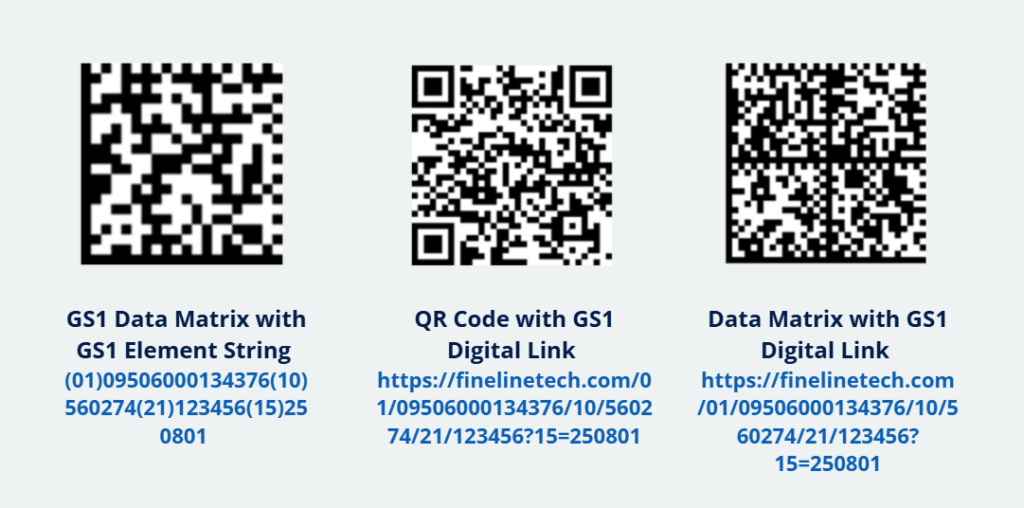
The first is GS1 DataMatrix using a GS1 element string, which is often the most straightforward from a data perspective. In this format, data is encoded using standardized Application Identifiers (AIs), such as GTIN (01), lot number (10), serial number (21), and expiration date (17). A typical example might look like:
(01)09506000134376(10)560274(21)123456(17)250801
This structure is highly efficient and compact, making it particularly well-suited for environments where space is limited or where detailed product data is required. It’s widely used in industries like healthcare and industrial manufacturing, where traceability and accuracy are critical, but consumer interaction is not the primary focus.
Another option is using a QR code with GS1 Digital Link, which shifts the structure from a traditional element string to a web-based format. Instead of encoding raw data, the barcode contains a URL that points to structured product information. For example:
https://finelinetech.com/01/09506000134376/10/560274/21/123456?15=250801
This format is especially powerful because it serves a dual purpose. It can be read by retail or operational systems for product identification, while also allowing consumers to scan the same code with a smartphone to access digital experiences such as product details, sustainability information, or brand content. For brands looking to combine operational efficiency with marketing or engagement, this is often the preferred approach.
The third option is DataMatrix with GS1 Digital Link, which combines the compact size of DataMatrix with the flexibility of a web-based data structure. This is typically used in situations where packaging constraints prevent the use of a QR code, but there is still a desire to enable consumer-facing experiences. This could use the same GS1 digital link in the previous example: https://finelinetech.com/01/09506000134376/10/560274/21/123456?15=250801
Choosing the Right 2D Barcode for Your Application
While all three formats are valid under Project Sunrise, the right choice depends on a few key factors. Packaging space is often the first consideration, as DataMatrix symbols are more compact and can fit on smaller labels. The second is whether there is a need for consumer interaction, if so, GS1 Digital Link becomes much more relevant. Finally, the level of data required plays a role, as element strings are often preferred for internal operations that rely on structured, standardized data.
One of the most important decisions within any of these formats is the syntax itself, specifically, what data you choose to encode. At a minimum, most implementations include a GTIN. However, many brands are now moving toward encoding both GTIN and a serial number to enable item-level traceability. Additional attributes such as lot number and expiration date can also be included depending on the application.
This is where alignment across systems becomes critical. The data encoded in your 2D barcode should match what exists in your backend systems, and if you are using RFID, it should also align with your EPC structure. Inconsistent data formats or mismatches between barcode and RFID encoding can create downstream issues that are difficult to troubleshoot later.
For many organizations, the challenge isn’t understanding the options, it’s knowing where to start. The transition to 2D barcodes touches multiple parts of the business, from packaging design to data management to operational workflows. Trying to solve all of that at once can slow progress.
A more effective approach is to start with a clear use case. Whether the goal is to support traceability, enable consumer engagement, or prepare for future point-of-sale requirements, defining that objective upfront helps narrow down both the symbology and the syntax. From there, brands can begin testing different formats, validating readability, and ensuring compatibility with existing systems.
How to Get Started with 2D Barcodes
At FineLine Technologies, we work with brands at every stage of this process. That includes helping define the right barcode strategy, selecting the appropriate symbology, structuring the data correctly, and ensuring alignment across labeling, RFID, and backend systems. Because we support both the physical label production and the underlying data requirements, we’re able to help bridge the gap between concept and execution.
Project Sunrise introduces new flexibility, but with that comes new complexity. Understanding the differences between symbology and syntax is a critical first step, not just for compliance, but for building a solution that actually delivers value.
The shift to 2D barcodes isn’t just about fitting more data into a symbol. It’s about making that data usable, connected, and aligned across the entire product lifecycle, and that starts with choosing the right foundation.